Research Peptide Traceability: What It Means
Learn what research peptide traceability actually requires: the identity, purity, label, and report chain that proves a vial is what it claims.
- Author
- Peptesa
- Published
- Reading time
- 11 min
- Sources
- 2 cited
This guide covers research documentation. It does not provide medical, diagnostic, therapeutic, or veterinary guidance.

A researcher opens a vial, checks the printed lot number, and assumes that number means something. But a lot number by itself is just a string of characters - research peptide traceability is what transforms it into proof. It's an unbroken record that links the physical vial in your hand to the identity test, purity test, label claim, and lab report that describe it. If any one of those links is missing, what you're holding is unverified, no matter how official the label looks.
After evaluating how research suppliers document their materials, the pattern is consistent: "traceability" appears constantly in marketing copy, but it's rarely defined with precision. Let's fix that.
What Is Research Peptide Traceability?
Research peptide traceability is the documented, checkable path connecting a specific vial to the lot it came from, and connecting that lot to the identity test, purity test, label information, and lab report that verify what's actually inside it. In practical terms: you should be able to take the lot number off a vial, pull up the corresponding report, and confirm that the report's identity result, purity result, and stated quantity all match what the label claims.
That's a meaningfully higher bar than most people assume. A lot number printed on a label tells you a supplier grouped some vials together during production. It does not, by itself, tell you that any laboratory tested that specific lot, or that the report sitting on a website actually belongs to the vial in front of you. Traceability only exists when the number on the vial, the claims on the label, and the results in the report all point to the same event.
A supplier can claim traceability. Only a documented chain can prove it. The Peptesa research library treats traceability as a structural requirement rather than a feature to advertise.
The Identity-Purity-Label-Report Chain
Four links have to hold for traceability to be real. Miss one, and the chain is broken.
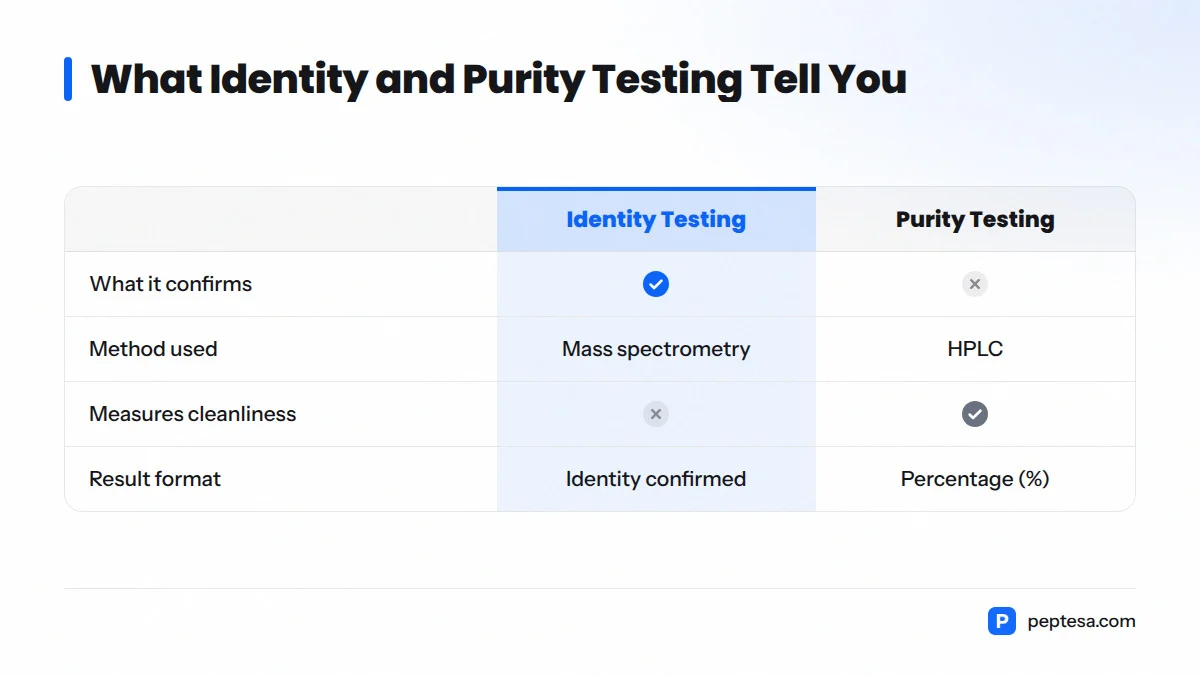
Identity: What it confirms
Identity testing answers one question: is this actually the peptide it's supposed to be? Methods like mass spectrometry compare the molecular structure of the material in the vial against the expected structure of the named peptide. A result here confirms the compound's identity, not how clean it is or how much of it there is. For a deeper look at how identity testing works alongside purity testing, see peptide identity, purity, and content explained. For a side-by-side look at the two main test types, read HPLC purity vs mass spectrometry identity.
Purity: What it confirms
Purity testing, typically done by high-performance liquid chromatography (HPLC), measures how much of the vial's content is the target peptide versus residual solvents, byproducts, or degradation. A purity result is usually expressed as a percentage. It tells you how clean the material is. Identity and purity are always reported as separate, paired results rather than one combined "quality" score, because purity says nothing about whether the material is the right compound in the first place.
Label: What it must state and match
The physical label on a vial is the first thing a researcher sees, and it needs to match the report, not just look official. A label that supports traceability should state the peptide name, the lot or batch number, the quantity or concentration claimed, and a research-use-only designation. None of that is traceability on its own - it's the claim that the report either confirms or contradicts. For a full walkthrough of what a compliant label should include, see how to read a research peptide label.
Report: The tying document
The certificate of analysis (COA) or lab report ties everything together. It should show the lot number, the testing laboratory, the test methods used, the identity result, the purity result, and a date. The report is the only document in the chain that can actually confirm the other three links are telling the truth, which is why mismatched or missing reports are the most common way traceability fails in practice. Learn how to read one properly in how to read a peptide certificate of analysis, and how to verify one before trusting it in how to verify a peptide COA before you rely on it.
The Four-Link Chain at a Glance
- Identity - confirms the vial contains the correct peptide
- Purity - confirms how clean that peptide is, expressed as a percentage
- Label - states the lot number, quantity, and compound name the report should confirm
- Report - the COA or lab report that ties identity, purity, and label claims to one documented lot
A lot number alone is not traceability. It's a pointer. Traceability is whether that pointer actually leads somewhere verifiable.
How a Vial Links to Its Records
Think of the chain as a straight line, where every arrow represents a documented, checkable step rather than an assumption:
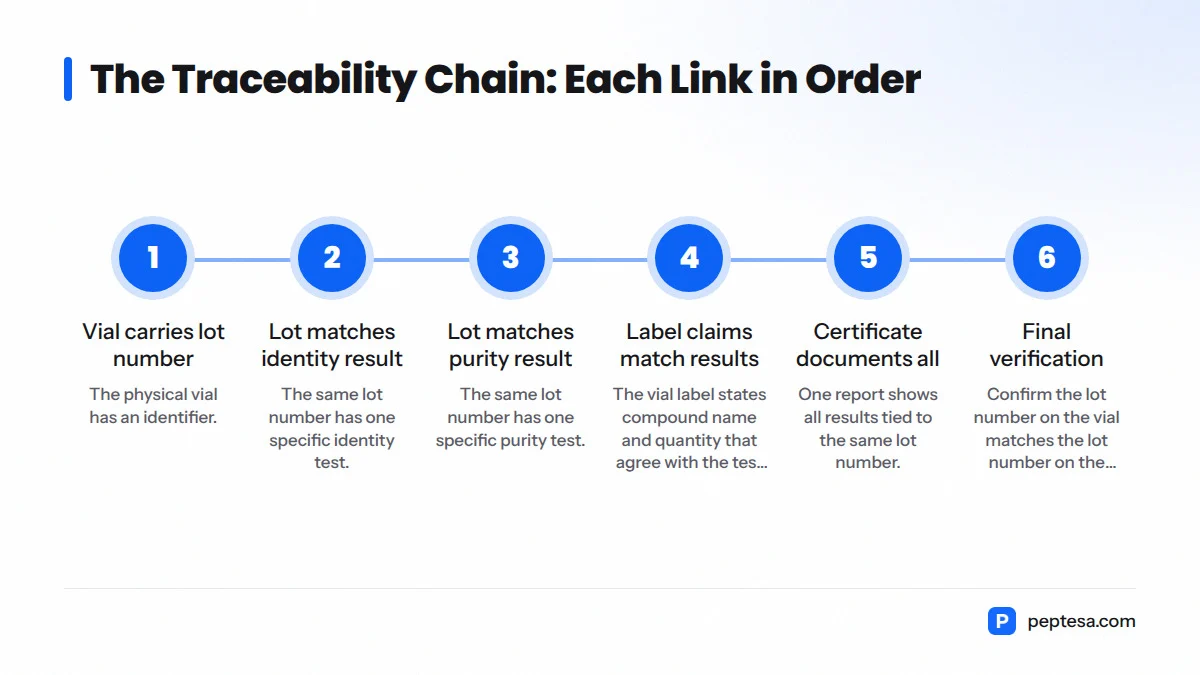
Vial - Lot/Batch Number - Identity Test Result - Purity Test Result - Label Claims - Certificate of Analysis - Matched Record
Each step is a place where the chain can hold or break. The vial carries a lot number. The lot number should correspond to one specific identity test result and one specific purity test result. The label should state claims that match those results. The certificate of analysis should document all of it in one place. The final step is simply confirming that the lot number on the vial and the lot number on the report are the same one. Skip that step and you've verified a report exists, not that it describes your vial.
Why Documentation Matters
Traceability exists because research depends on knowing what's actually in front of you. Without it, a researcher has no way to confirm that a reported purity value, an identity confirmation, or a stated concentration actually applies to the specific vial being used in an experiment. That matters for reproducibility, for comparing results across labs, and for basic accountability when something doesn't perform as expected.
A full, matched chain lets a researcher verify three things independently: that the compound is what it claims to be, that it's as clean as claimed, and that the specific lot in hand was the one actually tested, not a different lot from the same product line. Without that verification, researchers rely entirely on trust rather than documentation, which defeats the purpose of having lab reports at all.
Where Chains Break in Practice
Traceability chains don't usually fail all at once. They fail at specific, predictable points, and recognizing these patterns helps you ask the right questions before you rely on a vial.
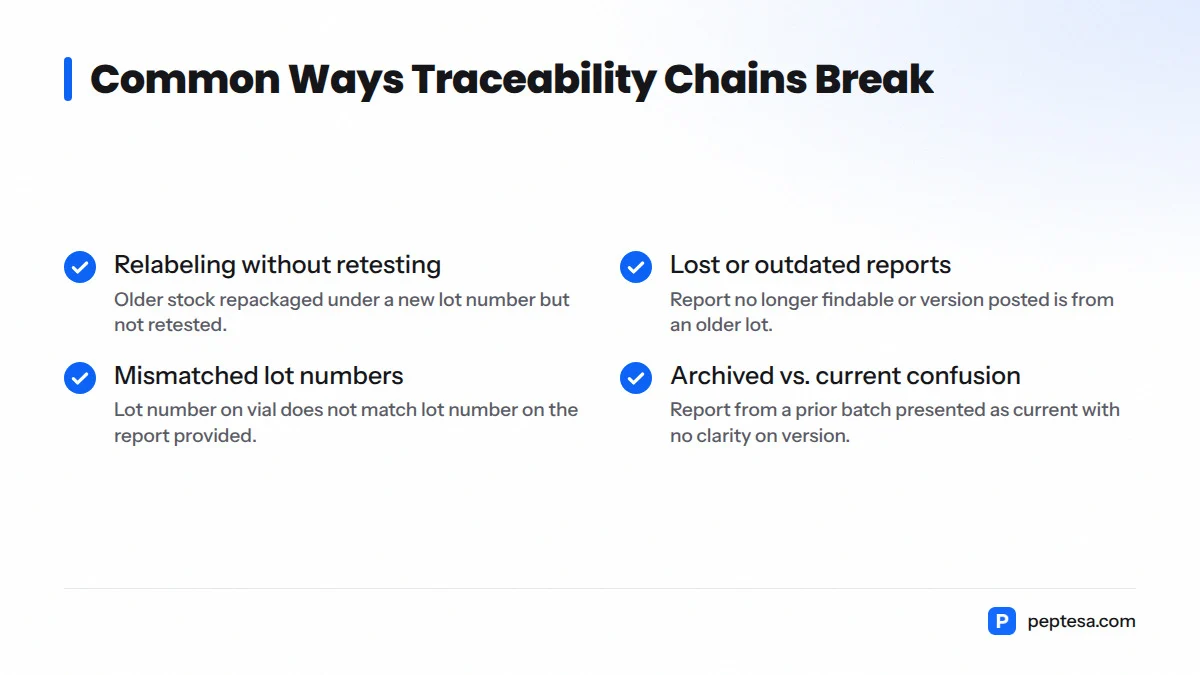
- Relabeling without retesting. A supplier repackages or relabels older stock under a new lot number without commissioning a new identity or purity test, so the label no longer matches any actual report.
- Lost or outdated reports. A report existed at some point but isn't findable anymore, or the version posted online is from an older lot than the one currently shipping.
- Mismatched lot numbers. The lot number on the vial doesn't match the lot number printed on the report a supplier provides, often because reports get reused across production runs.
- Archived vs. current report confusion. A supplier posts a report that was accurate for a prior batch but presents it as current, leaving no way to tell whether it still applies. The differences between these document states are covered in current, corrected, and archived lab reports.
None of this means every supplier has broken documentation. It means the chain has specific failure points, and a researcher who knows where to look can check for them directly instead of taking a label at face value.
How Peptesa Approaches Lot Tracking
Peptesa is a prelaunch, research-use-only brand with no products or public lab reports available yet. The architectural principle its system is being built around is straightforward: every lot is meant to carry one identity result, one purity result, one label specification, and one report, tied together by a single lot number that appears identically in all four places.
The intent is clear. Rather than treating a certificate of analysis as a document published somewhere separate from the product, the lot number itself becomes the key that should let a researcher pull up the exact report matching the exact vial, every time, with no ambiguity about which version is current. That's the standard this page holds every supplier to, including the one eventually built on peptesa.com. You can read more about the quality principles guiding that build on the Quality page, and about the broader research-use boundary Peptesa operates within at the research-use boundary page.
Traceability vs Related Terms
These four terms get used interchangeably in casual conversation, but they describe different things. Knowing the distinction helps you ask suppliers more precise questions.
| Term | What It Actually Means | What It Does NOT Mean |
|---|---|---|
| Traceability | An unbroken, matched chain linking a vial's lot number to its identity, purity, label, and report | Just having a lot number printed on a label |
| Certificate of Analysis (COA) | A single document reporting test results for a specific lot | Proof on its own that the document matches the vial in hand |
| Batch/Lot Number | An identifier assigned to a production run, used to group and track material | A guarantee that testing occurred or that a report exists |
| Chain of Custody | A record of who physically handled or transferred material, typically used in regulated or legal contexts | The same as testing or documentation of identity and purity |
A COA is one piece of evidence. A lot number is one identifier. Chain of custody tracks handling, not composition. Traceability is the only term that requires all of those pieces to connect to one verified result.
Next Steps for Each Part of the Chain
This page is a starting point. Depending on which link in the chain you need to check, here's where to go:
- Label questions? Read how to read a research peptide label.
- Understanding a report? Read how to read a peptide certificate of analysis.
- Verifying a COA's authenticity? Read how to verify a peptide COA before you rely on it.
- Matching lot numbers to reports? Read how to match a lot number to a lab report.
- Understanding testing methods? Read peptide identity, purity, and content explained or HPLC purity vs mass spectrometry identity.
- Checking lab accreditation? Read how to check a laboratory's ISO/IEC 17025 scope.
- Evaluating a supplier broadly? Read how to evaluate a research peptide supplier.
- Understanding research-use-only? Read what research-use-only means.
Accredited testing laboratories that issue these reports are often certified against ISO/IEC 17025, the international standard covering the general competence of testing and calibration laboratories, according to the International Organization for Standardization. That accreditation applies to specific tests within a defined scope, which is exactly why checking scope matters more than checking for a badge.
For a visual walkthrough of how researchers vet peptide sources, watch this brief overview:
https://www.youtube.com/watch?v=kkQFw0qxNzU
FAQ
What is research peptide traceability? It's the documented, checkable link between a specific vial's lot number and the identity test, purity test, label claim, and lab report that all describe that same lot. Without all four pieces matching, there's no traceability, only a label claim.
What records must link a vial to its lot? At minimum, a report showing the identity result, the purity result, and the lot number, plus a label stating the same lot number and matching compound name and quantity.
Why does a lot number alone not prove traceability? A lot number is an identifier, not evidence. It tells you vials were grouped together during production. It doesn't confirm a laboratory tested that lot or that a report actually exists for it.
What's the difference between a batch number and a lot number? The terms are often used interchangeably, though some manufacturers reserve "batch" for a full production run and "lot" for a tested sub-portion of that run. What matters for traceability is that whichever term is used, it appears identically on the vial, the label, and the report.
What's the difference between traceability and chain of custody? Traceability confirms what a lot actually is, through identity, purity, label, and report matching. Chain of custody tracks who physically handled or transferred material, which is a separate concern more common in regulated or forensic contexts.
How does Peptesa structure its lot-tracking system? Peptesa, which is prelaunch with no products or public lab reports yet, is designing its system so every lot number ties to exactly one identity result, one purity result, one label specification, and one report, with no ambiguity about which version is current.
What is ISO/IEC 17025 and why does it matter for traceability? ISO/IEC 17025 is the international standard for the general competence of testing and calibration laboratories, maintained by the International Organization for Standardization. It matters because accreditation applies to specific test scopes, so confirming a lab's scope actually covers the test performed is part of checking whether a report is credible.
How can a researcher verify a supplier's traceability claims? Pull the lot number off the vial, find the corresponding report, and confirm the identity result, purity result, and label claims all match that exact lot rather than a similar or older one. The detailed steps for this are covered in how to match a lot number to a lab report.
The Bottom Line
Traceability is a concept you should be able to verify yourself in a few minutes, not something you have to take on faith. Once you understand the identity-purity-label-report chain, you stop reading "traceable" as a marketing word and start reading it as a claim you can check.
Peptesa is building toward launch with this chain as a structural requirement, not an afterthought. To follow that process, join the launch list through the contact page, and keep an eye on the research library for the traceability chain checklist and the sibling guides linked above as they go live.
Documentation lead: Peptesa Research Editorial Team. Last updated October 7, 2026.
Sources
Sources
- ISO/IEC 17025 - Testing and Calibration Laboratories, International Organization for Standardizationwww.iso.org
- https://www.youtube.com/watch?v=kkQFw0qxNzUwww.youtube.com
Found a factual error or a source that needs revision? Please save the page URL and contact Peptesa through the launch email once that channel opens.