What Is the Wolverine Peptide? Behind the Viral Name
The Wolverine peptide can mean BPC-157 or a BPC-157/TB-500 stack. Learn why the nickname, molecular identity and lab report need separate checks.
- Author
- Peptesa
- Published
- Reading time
- 6 min
- Sources
- 5 cited
This guide covers research documentation. It does not provide medical, diagnostic, therapeutic, or veterinary guidance.
A superhero name is easy to remember. A peptide specification takes a little more reading. That gap helps explain the confusion around the “Wolverine peptide”: the same nickname can point to different descriptions before anyone has opened a laboratory report.
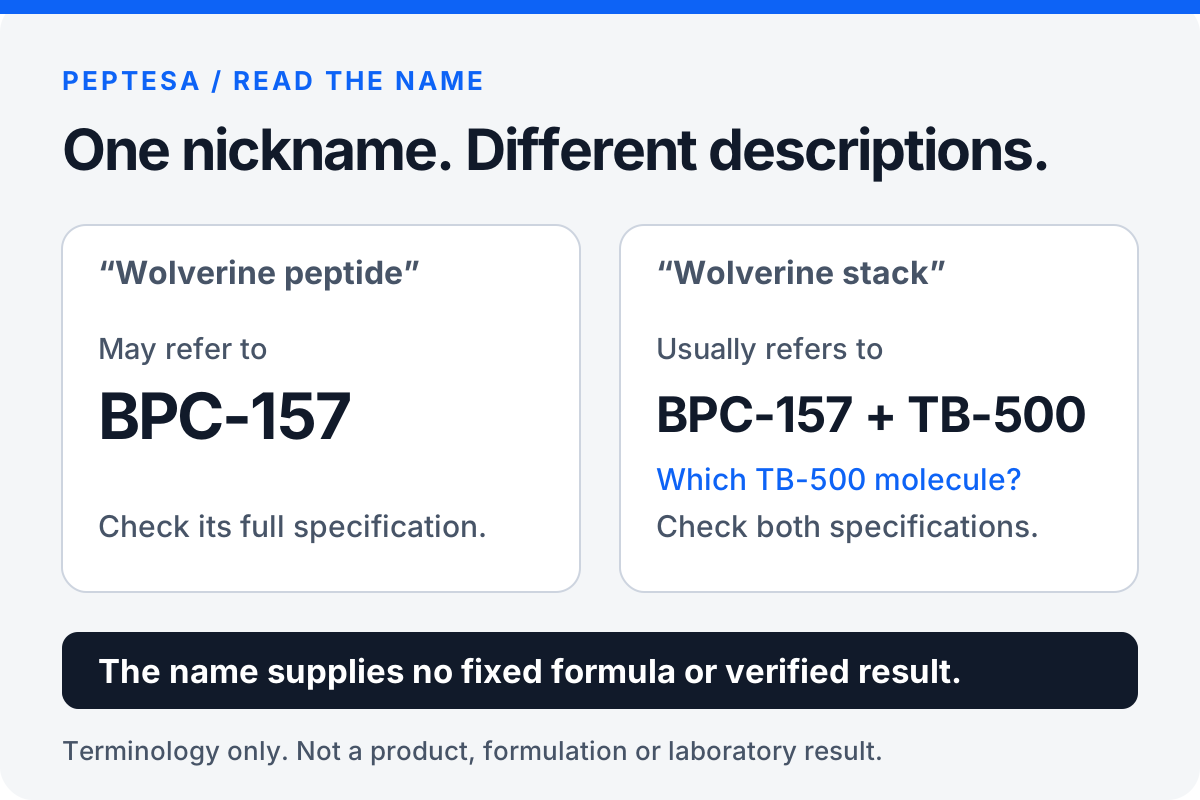
The Wolverine peptide is an informal nickname used for BPC-157. “Wolverine stack” usually refers to BPC-157 paired with a substance labeled TB-500. The nickname alone does not specify a single molecule, a fixed blend or a verified test result.
That is the first thing to resolve when two posts appear to disagree. One may be discussing BPC-157 alone; the other may be describing a combination. Even then, the letters “TB-500” need a closer look.
This article explains the terminology and research documentation behind the name. Peptesa remains in prelaunch, and this is not a product listing or guidance for human or veterinary use.
Why the Wolverine name gets attention
The reference is to the comic-book character, whose fictional abilities give the word an instant association with extraordinary repair. It is a memorable piece of shorthand, especially when a headline has only a few seconds to explain itself.
The language has reached university science commentary: McGill’s Office for Science and Society discussed the Wolverine stack in September 2026, identifying the pairing as BPC-157 and TB-500. That establishes how the nickname is being used in public discussion. It does not turn the character’s abilities into properties established for a research sample.
Before following the story any further, ask a plain question: which substance does this source mean?
Wolverine peptide vs. Wolverine stack
The singular and the combination should not be treated as interchangeable.
In its July 2026 BPC-157 briefing, FDA records a clinic’s use of the phrase “wolverine compound” for BPC-157. Separately, the McGill article uses “Wolverine stack” for the two-peptide pairing. Those are different descriptions, even though a search engine may return them together.
| Term you encounter | What the source may mean | What still needs checking |
|---|---|---|
| Wolverine peptide or compound | BPC-157 alone | Full chemical description and the supporting sample record |
| Wolverine stack or blend | BPC-157 plus a substance labeled TB-500 | The identity of each component and whether a defined mixture is actually described |
| TB-500 | A common name associated with a thymosin beta-4 fragment | Exact sequence, modifications and supplied chemical form |
| Thymosin beta-4 | The full-length peptide | Whether the source really means the full-length molecule or a fragment |
A “stack” in an online discussion also does not tell you whether a document describes one mixed sample or separate materials. A laboratory report should make its own sample description explicit. Leave missing composition information unresolved instead of filling it in from the nickname.
The TB-500 detail that changes the comparison
This is where the shorthand can become misleading even after someone names both components.
FDA’s TB-500 briefing, section II.A, describes TB-500 as an N-acetylated seven-amino-acid fragment corresponding to positions 17 through 23 of thymosin beta-4. The full-length peptide contains 43 amino acids. The document explicitly distinguishes the substances and notes inconsistent commercial naming.
You do not need to memorize the sequence to see the problem. A paper studying the full-length molecule and a report identifying a short fragment concern different chemical entities. Replacing the longer name with “TB-500” while summarizing the paper can lose that distinction.
There is original analytical research behind the fragment description. In a 2012 study by Esposito and colleagues, the researchers identified an acetylated fragment spanning positions 17 through 23 in the TB-500 material they examined using chromatography and mass spectrometry. That result concerns their analyzed material; it does not identify everything later sold under the same label.
For a research record, retain the exact sequence and any terminal modifications. Our peptide-label guide explains how to compare those details without assuming that similar names describe identical materials.
BPC-157 also needs a complete description
A more familiar component name does not finish the specification either.
FDA’s BPC-157 briefing describes a 15-amino-acid peptide and separately evaluates the free base and acetate form. It also records naming inconsistencies. That is a reason to preserve the chemical form in your notes rather than shorten every entry to “BPC.”
When comparing a label with a paper or certificate, copy the complete material description first. Check what form the source actually studied, then compare it with the document you have. If that detail is absent, say so. A matching short name cannot supply a missing specification.
These FDA documents were prepared for a July 2026 advisory committee. Their chemical descriptions are useful here; citing a briefing is not evidence of product approval or a statement about the current legality of a particular seller.
What a lab report can establish about a blend
A report with the word “Wolverine” at the top still needs to identify what the laboratory assessed.
Read its sample description and results together. Does the report address BPC-157 and the stated TB-500 material separately? Does it explain the identification evidence for each? If it gives a quantity, what exactly was measured?
Waters distinguishes identification from quantitation in its HPLC primer. Identifying a compound and determining how much is present answer different questions. A numerical result needs a suitable quantitative basis, including the method’s reference comparison or calibration.
That is why a prominent purity percentage cannot, on its own, establish the amount of each component in a blend. Two visible peaks are not automatically an equal-mass mixture. Start with the peak assignments and the calculation, rather than guessing composition from the graph. Our identity, purity and content guide covers those reporting distinctions in more detail.
Consider this fictional documentation example, unrelated to any Peptesa product or test:
| Record | Information supplied | What remains unresolved |
|---|---|---|
| Listing | “Wolverine blend” | Components and chemical specifications |
| Label | BPC-157 plus TB-500 | Which TB-500 sequence and form are intended |
| Report | One overall chromatographic percentage | Whether each component was identified and quantified, and how the percentage was calculated |
None of those missing answers can be recovered from the superhero name. A useful follow-up is: “Please provide the full specification for each stated component and the lot-linked report showing which identity and quantity results were measured.”
Check the report’s origin too. Our COA verification guide explains how to compare a supplied copy with its issuing laboratory’s record. An authentic report and a complete answer about a blend are separate findings.
Questions about the Wolverine peptide
Is the Wolverine peptide the same as BPC-157?
Sometimes that is what the speaker means. Check the surrounding description: “Wolverine stack” commonly means the BPC-157/TB-500 pairing instead. Ask which material is being discussed before comparing claims or reports.
Are TB-500 and thymosin beta-4 the same thing?
FDA’s July 2026 briefing distinguishes the N-acetylated seven-amino-acid TB-500 fragment from full-length thymosin beta-4. Because public naming is inconsistent, use the exact chemical specification to establish which one a document describes.
Does a COA prove the claims attached to the nickname?
A certificate reports specified analyses on an identified sample. Read the methods and limitations to determine what those results establish. A document about identity or chromatographic purity does not, by itself, substantiate a broader biological claim.
What should I save when researching the term?
Keep the original source, the full component descriptions and any report identifiers together. For a specific research lot, retain the connection between the lot and laboratory report. You should be able to tell which molecule each statement concerns without relying on the word “Wolverine.”
Sources
- BPC-157-Related Bulk Drug Substances: FDA Briefing Document, July 2026U.S. Food and Drug Administration · Accessed October 16, 2026
- TB-500-Related Bulk Drug Substances: FDA Briefing Document, July 2026U.S. Food and Drug Administration · Accessed October 16, 2026
- Synthesis and characterization of the N-terminal acetylated 17-23 fragment of thymosin beta 4 identified in TB-500Esposito et al., Drug Testing and Analysis (2012), abstract · Accessed October 16, 2026
- Identifying and Quantitating Compounds Using HPLCWaters · Accessed October 16, 2026
- Biohackers are Reaching for Wolverine PeptidesMcGill University, Office for Science and Society · Accessed October 16, 2026
Found a factual error or a source that needs revision? Please save the page URL and contact Peptesa through the launch email once that channel opens.